

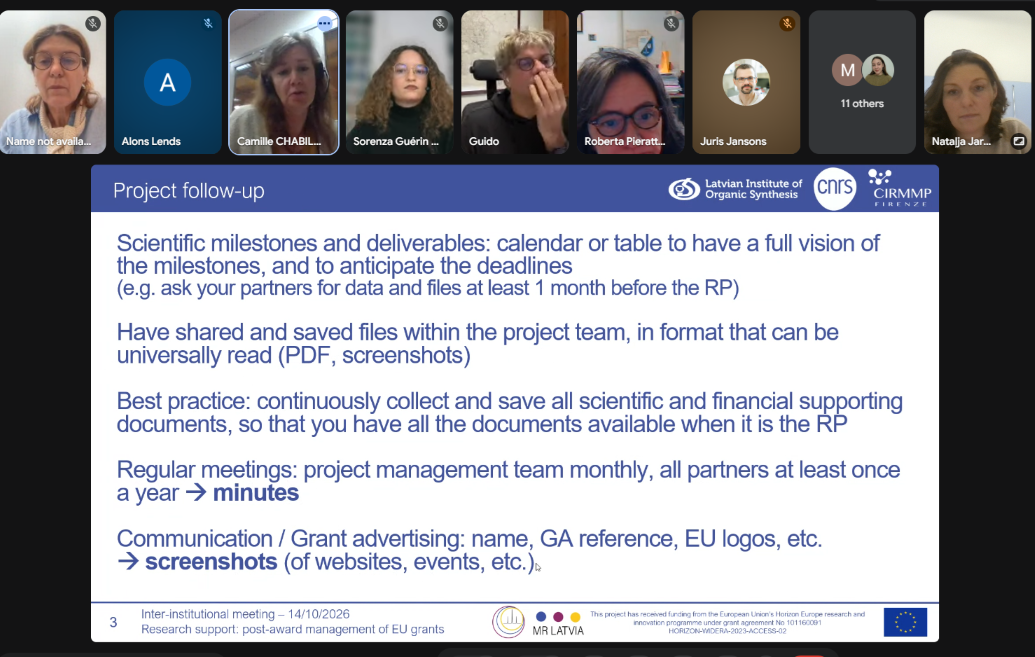
On 14 October 2026, the MR LATVIA project and CRMN Lyon (France) held the inter-institutional webinar "Research support: post-award management of EU grants". Alons Lends opened the session. Four expert presentations covered the main stages of managing a funded project, from signing the grant to final reporting, and were followed by a Q&A with participants.
Grant Agreement and Consortium Agreement
Zsoka Bori, CNRS regional delegation
The grant agreement is the binding reference for a Horizon Europe project, and Annex 1 (the Description of Action) sets out its scientific roadmap. Amendments require agreement within the consortium, approval from the project officer and a formal request. Key recommendations for coordinators:
- Negotiate with the European Commission on behalf of all beneficiaries, who then sign accession forms within 30 days of the Commission's signature.
- Prepare ethics documentation in advance, as ethics clearance is required before the grant agreement is signed.
- Keep partners informed, communicate in English through the portal's communication center and record all consortium-level decisions.
- Sign the Consortium Agreement before the grant agreement where possible. Begin negotiations early, share all partner comments transparently and favour mediation for dispute resolution.
Scientific follow-up and progress reporting
Anne Lesage, CRMN Lyon
Reporting on the Funding and Tenders portal combines continuous updates (risks, deliverables, key performance indicators) with periodic reports that trigger interim and final payments. Milestones mark key points in the project timeline, while deliverables are formal outputs that are reviewed by the European Commission. Publications must be open access in trusted repositories such as HAL, and research data should follow the FAIR principles and be documented in an up-to-date data management plan.
Financial reporting
Camille Chabilan, CRMN Lyon
Good financial management depends on early planning and consistent documentation:
- Request partner data at least one month before each reporting deadline, and hold regular management meetings with documented minutes.
- Label work packages on orders, travel and other records so that expenses are easy to trace at reporting time.
- Plan recruitment, especially of PhD students, and equipment purchases ahead of time to avoid delays.
- Keep all scientific and financial documents for at least five years after project completion.
- Report significant changes to the grant authority through the portal, and request extensions with proper justification, ideally six months in advance.
Lump-sum funding rules
Lorenza Guerin, CNRS regional delegation
Lump-sum funding reimburses fixed amounts for completed work packages instead of actual costs, so no financial justification is required. Instead, the coordinator submits a technical and scientific report stating whether each work package is completed, partially completed or not completed. Pre-financing is set at 80%, minus a 5% mutual insurance mechanism. Audits may take place up to five years after final payment and focus on scientific evidence, such as lab books, technical files and publications.
Participants asked about lump-sum reporting and project extensions. Administrative teams have no financial reporting tasks under lump-sum funding, although experience with audits is still limited. Extensions are possible if well justified, for example in cases of delayed PhD recruitment, but they carry a significant administrative burden.
The event was supported by the MR LATVIA project (Development of Magnetic Resonance in Latvia), conducted in collaboration with the Centre de RMN à très hauts champs de Lyon (CRMN), France, the CERM/CIRMMP Infrastructure, Florence, Italy, and the Latvian Institute of Organic Synthesis (LIOS), Riga, Latvia. Funded by the HORIZON-WIDERA-2023-ACCESS-02 programme, this initiative aims to strengthen research capacities and scientific excellence across Europe.