

MR LATVIA is actively strengthening its European collaboration network through targeted visits that connect research excellence with practical facility readiness. In January 2026, two complementary activities—one at CNRS–CRMN (Lyon) and one at CERM/CIRMMP (Florence)—demonstrate how MR LATVIA is developing both the scientific depth and the operational foundation needed for high-field NMR work at scale.
Lyon, France | CNRS–CRMN (21–22 January 2026)
During a two-day working visit at CNRS–CRMN Lyon, MR LATVIA scientists and engineers work side-by-side with the CRMN team to align scientific priorities, refine collaboration practices, and learn directly from established facility workflows.
Scientific track: turning data into a structured 2026 plan
The scientific sessions are led by Dr. Alons Lends, focusing on advanced solid-state NMR analysis and interpretation. Work includes ¹H-detected solid-state NMR spectral analysis of virus-like particles (VLPs) and TTR protein samples, complemented by ¹⁹F spectra simulations (with Alvis) to support validation and interpretation. The programme also features in-depth discussions with Guido and Alvis, helping to connect current datasets with the next experimental and analytical steps.
A central outcome of the Lyon meeting is shared alignment on how the collaboration will run throughout 2026—including the cadence of data exchange, feedback loops, and coordinated cycles of measurement and interpretation. This strengthens the pathway from raw spectra to reproducible conclusions and future publishable outputs.
Engineering & operations track: learning from a mature facility model
In parallel, Ruslans Muhamadejevs works closely with CNRS–CRMN Lyon engineers to strengthen MR LATVIA’s operational readiness. Key elements include aligning a practical user support approach, reviewing safety and access procedures, and learning from CRMN’s facility model through a guided walkthrough.
The walkthrough covers essential infrastructure and routines, including cryogenic refilling systems, the division of responsibilities for instrument and magnet maintenance procedures, and demonstrations of automation systems used for monitoring and reliable day-to-day operations. These insights provide concrete reference points for implementing robust practices within MR LATVIA.
Florence, Italy | CERM/CIRMMP Research Group Meeting (as a part of ESR visit)
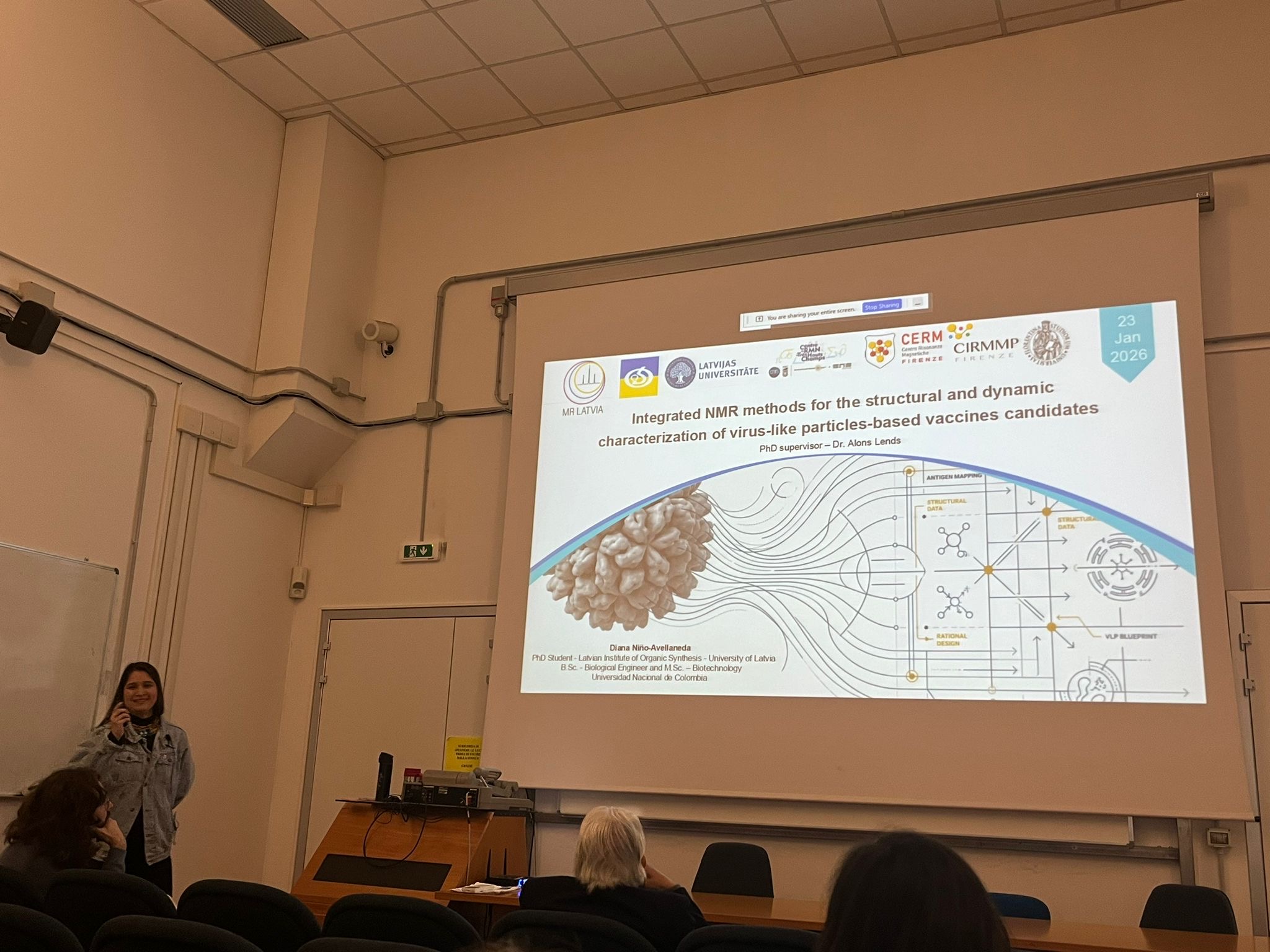
As part of her ESR visit to Florence, PhD student Diana Niño-Avellaneda participates in a CERM/CIRMMP Research Group Meeting, where she presents MR LATVIA scientific research results together with Dr. Marco Schiavina (CERM/CIRMMP).
The presentation highlights MR LATVIA’s ongoing work on integrated NMR methodologies for the structural and dynamic characterization of VLP-based vaccine candidates. The session is followed by valuable scientific discussion with colleagues at CERM/CIRMMP, enabling constructive feedback, cross-laboratory perspectives, and potential directions for strengthening methodological approaches and interpretation strategies.
Why these visits matter for MR LATVIA
Taken together, Lyon and Florence represent two sides of the same priority:
- Scientific progress through structured interpretation, simulation-supported validation, and research-level exchange
- Operational maturity through exposure to proven facility workflows, safety culture, and automation-supported reliability
- Stronger collaboration through working practices that support continuity and efficiency across 2026
We sincerely thank CNRS–CRMN Lyon and CERM/CIRMMP for hosting and for the constructive exchange. These collaborations strengthen MR LATVIA’s international partnerships and support continued progress in high-field NMR research, from facility readiness to advanced scientific outcomes.
Funded by the European Union. Views and opinions expressed are however those of the author(s) only and do not necessarily reflect those of the European Union or the European Research Executive Agency. Neither the European Union nor the granting authority can be held responsible.