

MR LATVIA team participated in EUROMAR 2026 in Gothenburg, Sweden, presenting the project’s achievements in advancing Nuclear Magnetic Resonance (NMR) research infrastructure, expanding international scientific collaboration, and engaging with technology developers to support the future development of NMR capabilities.
A key contribution of the conference was the presentation of the MR LATVIA ACCESS platform by Ruslands Muhamadejevs, highlighting opportunities for researchers to access advanced NMR services and expertise. The ACCESS platform is a central component of the MR LATVIA project, which aims to establish a regional Centre of Excellence in Nuclear Magnetic Resonance (NMR) at the National Institute of Research and Innovation (NIRI).
Funded under the HORIZON-WIDERA-2023-ACCESS-02 programme, the project is implemented in collaboration with internationally recognized NMR research partners: CRMN Lyon, represented by Guido Pintacuda, and the CERM/CIRMMP Research Infrastructure in Florence. These strategic partnerships support knowledge transfer, strengthen scientific capacity, and facilitate access to advanced NMR methodologies and high-level research services for the wider scientific community.
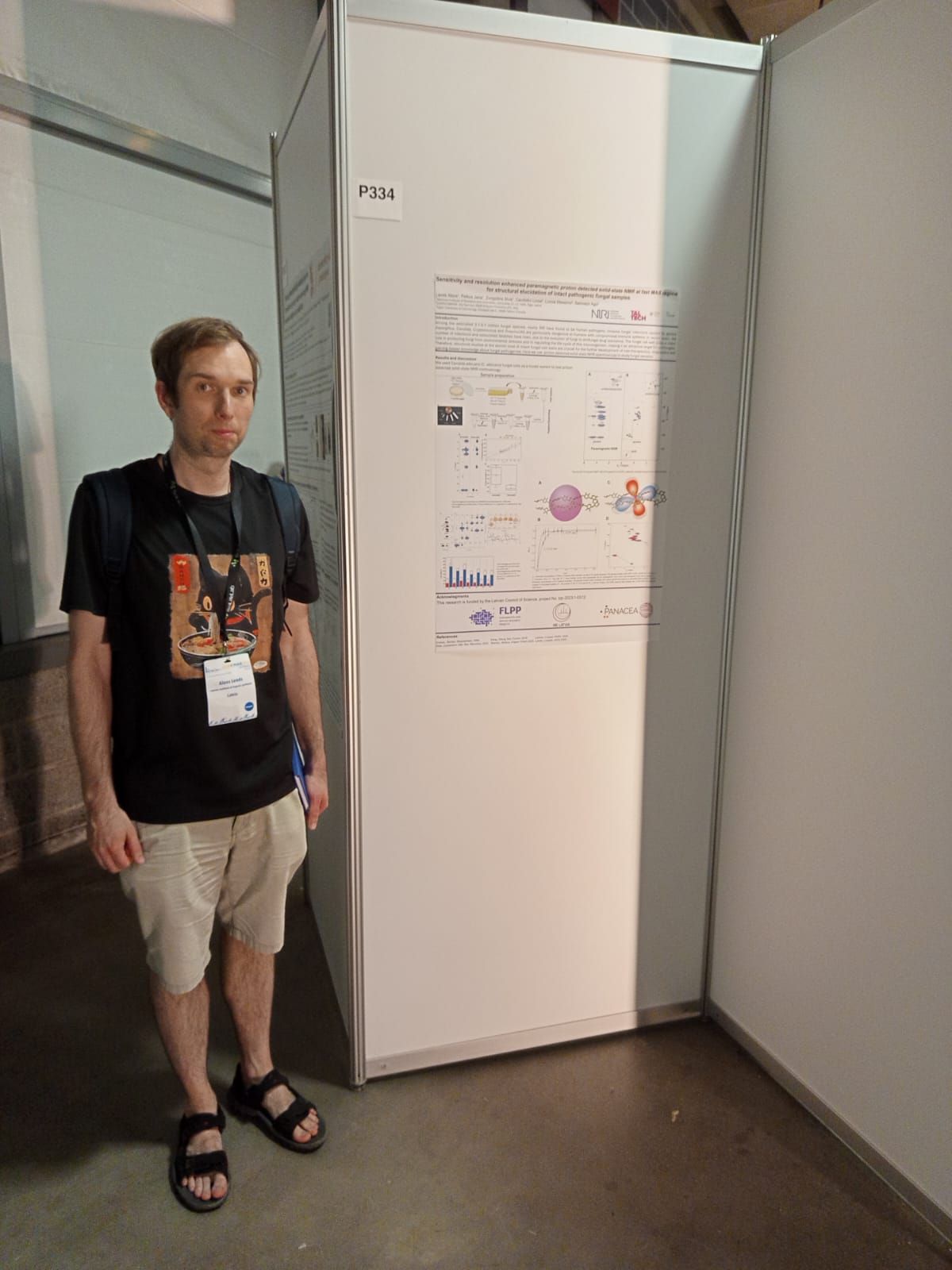
The scientific achievements developed within the MR LATVIA framework were represented through two research contributions. Alons Lends presented the study “Sensitivity and Resolution Enhanced Paramagnetic Proton-Detected Solid-State NMR at Fast MAS Regime for Structural Elucidation of Intact Pathogenic Fungal Samples.” The work demonstrates methodological advances in solid-state NMR, showing how enhanced sensitivity and resolution approaches can improve the structural characterization of complex biological systems, including intact pathogenic fungal samples. The research was presented at Poster #334.
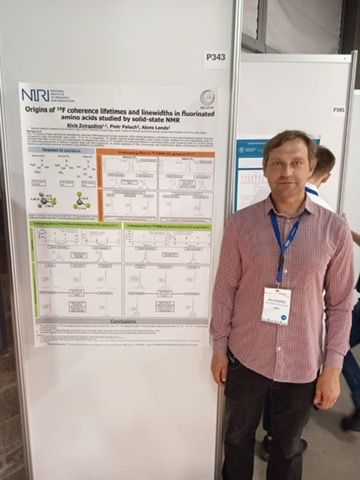
Alvis Zvirgzdiņš represented NIRI and the MR LATVIA project with the poster presentation “Origins of ¹⁹F Coherence Lifetimes and Linewidths in Fluorinated Amino Acids Studied by Solid-State NMR.” The study combines high-field solid-state NMR experiments with advanced numerical simulations to investigate the fundamental factors governing ¹⁹F coherence properties. These findings contribute to improving the application of fluorine-based NMR approaches in biomolecular research. The presentation was featured at Poster #343.
EUROMAR 2026 also provided an important platform for strengthening dialogue between academic researchers and NMR technology developers. Discussions with Bruker representatives focused on the future development of SpinPilot software, including opportunities to improve functionality, optimize user workflows, and address challenges identified during beta testing. These exchanges demonstrated the value of close collaboration between instrument developers and scientific users in shaping next-generation NMR solutions.
Engagement with JEOL representatives provided further insights into developments in NMR automation and software integration, including approaches for improving autosampler performance and configuration flexibility to meet evolving research needs.
The conference also highlighted advances in NMR infrastructure technologies that can contribute to more sustainable and efficient research environments. Bluefors presented the Cryomech Helium Reliquefier, a technology aimed at reducing liquid helium consumption by enabling near zero-boil-off operation for a broad range of NMR magnets. Such developments have the potential to improve the long-term sustainability of NMR facilities by reducing operational demands and optimizing laboratory resources.
Further technological developments showcased at EUROMAR 2026 included emerging solutions in analytical standards and instrumentation, including new qNMR standards from HPC Standards GmbH and the growing presence of CIQTEK as a manufacturer of superconducting NMR magnets. These developments reflect continued innovation and diversification within the global NMR technology ecosystem.
The scientific programme also demonstrated the rapidly growing role of artificial intelligence (AI) in NMR research. Numerous presentations and posters highlighted AI-driven approaches for accelerating spectral analysis, supporting automated peak assignment, and improving chemical shift prediction. These emerging methodologies have significant potential to enhance efficiency and expand the capabilities of NMR-based research.
Participation in EUROMAR 2026 strengthened the MR LATVIA project’s connections with the international NMR community and reinforced the importance of collaboration between research institutions, infrastructure providers, and industry partners. Through scientific exchange and strategic partnerships, MR LATVIA continues to contribute to the development of advanced NMR research capabilities and the future growth of the field.