

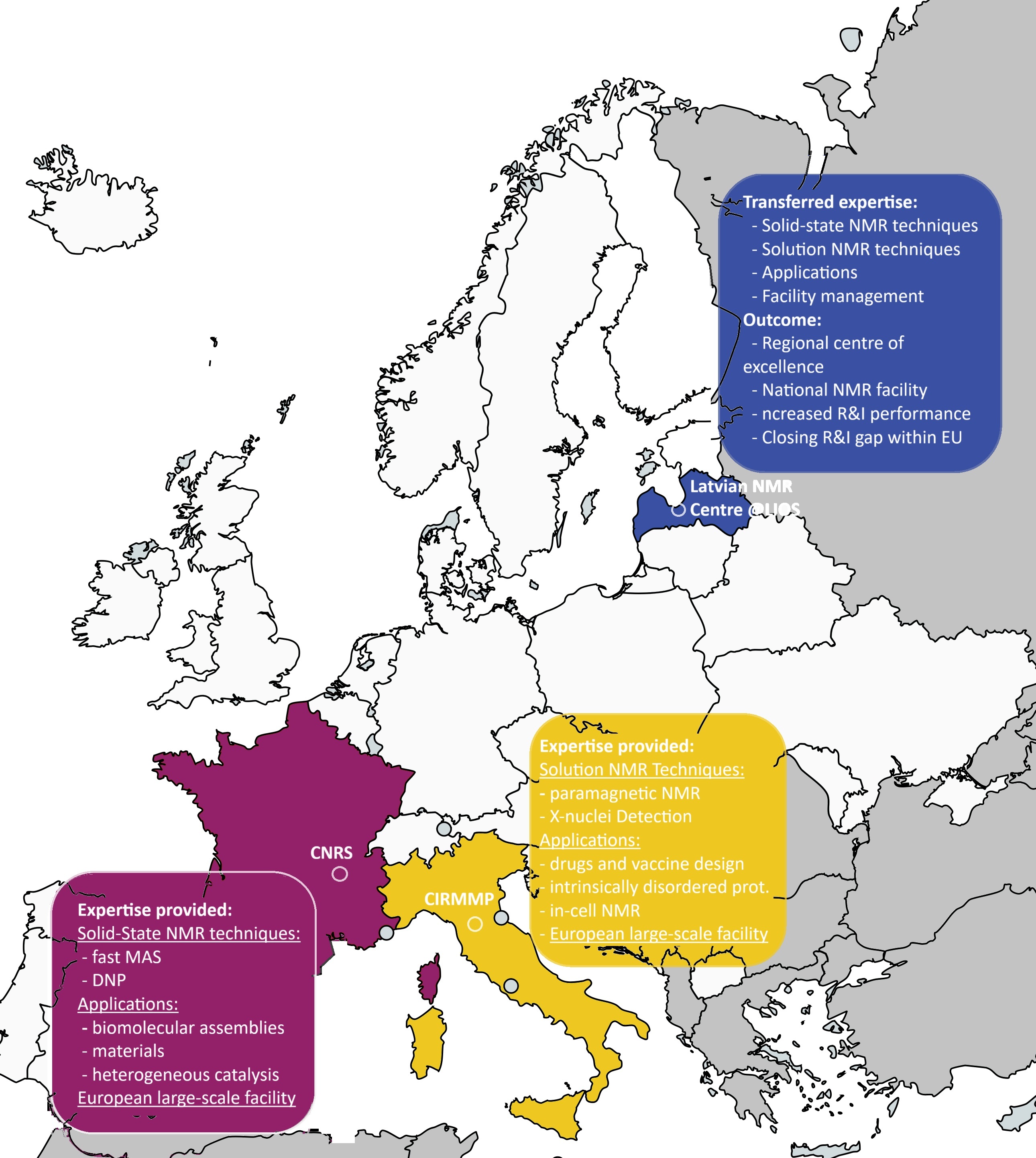
On September 16, it will be one year since the first meeting of partners in Riga, which marked the launch of the ambitious MR LATVIA project to establish the Latvian Centre for Nuclear Magnetic Resonance (NMR) Spectroscopy. Over the next two years, the Latvian Institute of Organic Synthesis (LIOS), one of the project’s key participants, will establish the largest nuclear magnetic resonance centre in the Baltics.
In partnership with Europe’s leading NMR centres — the CRMN in Lyon, France, and the CERM/CIRMMP in Florence, Italy — LIOS is implementing the project “Development of Magnetic Resonance in Latvia” (MR LATVIA). The initiative is supported by the prestigious European HORIZON WIDERA programme, which aims to boost regional research capacity and strengthen Latvia’s position as a leading Baltic NMR Centre.
The centres in Lyon and Florence are globally recognised leaders in NMR research. Their expertise will provide a vital foundation for the development of Latvia’s future centre and for advancing NMR capabilities across the Baltics.
What is NMR and why is the NMR Centre being developed at LIOS?
Dr. Alons Lends, Head of the NMR Centre, highlights the importance of these technologies for modern science: “Nuclear magnetic resonance spectroscopy allows us to study the structure and dynamics of substances at the atomic level. It plays a critical role in the discovery and development of new drugs. Much like an MRI scan provides physicians with a detailed view of the human body, NMR spectroscopy enables scientists to understand how potential drugs interact with their biological targets.”
Year One: Major Achievements and International Collaboration
In its first year, MR LATVIA focused on exchanging expertise and adopting best practices from European partners. Latvian researchers and PhD students participated in leading conferences such as EUROMAR 2025 (Oulu, Finland), international seminars, webinars, and training events including the PANACEA Week 2025 Summer School (Lyon, France) and ITACA SB School (Florence, Italy). Dr. Lends emphasizes: “MR LATVIA’s activities in the first year have strengthened knowledge exchange, built research capacity, and integrated cutting-edge expertise into Latvian science. Importantly, they have also given young researchers and PhD students their first real steps into the world of NMR.”
Ambitious Future Plans
The long-term vision of MR LATVIA is to establish LIOS as an internationally recognized NMR centre of excellence, specializing in innovative technologies and spanning a wide range of R&D applications. In spring 2026, MR LATVIA will launch a call to provide free access to its NMR infrastructure for researchers and entrepreneurs across the Baltics, fostering knowledge transfer and driving innovation throughout the region. All calls and updated news will be available on our website: http://mrlatvia.osi.lv.
International partners stress that collaboration is essential not only for advancing methodologies but also for expanding access to cutting-edge NMR technologies in the Baltics – contributing to the strength of the European scientific community.
Project coordinator Dr. Alons Lends concludes: “MR LATVIA has already gained strong momentum thanks to the active involvement of dynamic researchers and doctoral students. In the next phase, our main priorities will be to ensure free access and trainings to our facilities for Baltic States researchers and entrepreneurs and, still conducting NMR based research. We invite everyone to follow our progress and seize this unique opportunity to shape the future of Baltic science and innovation together.”