

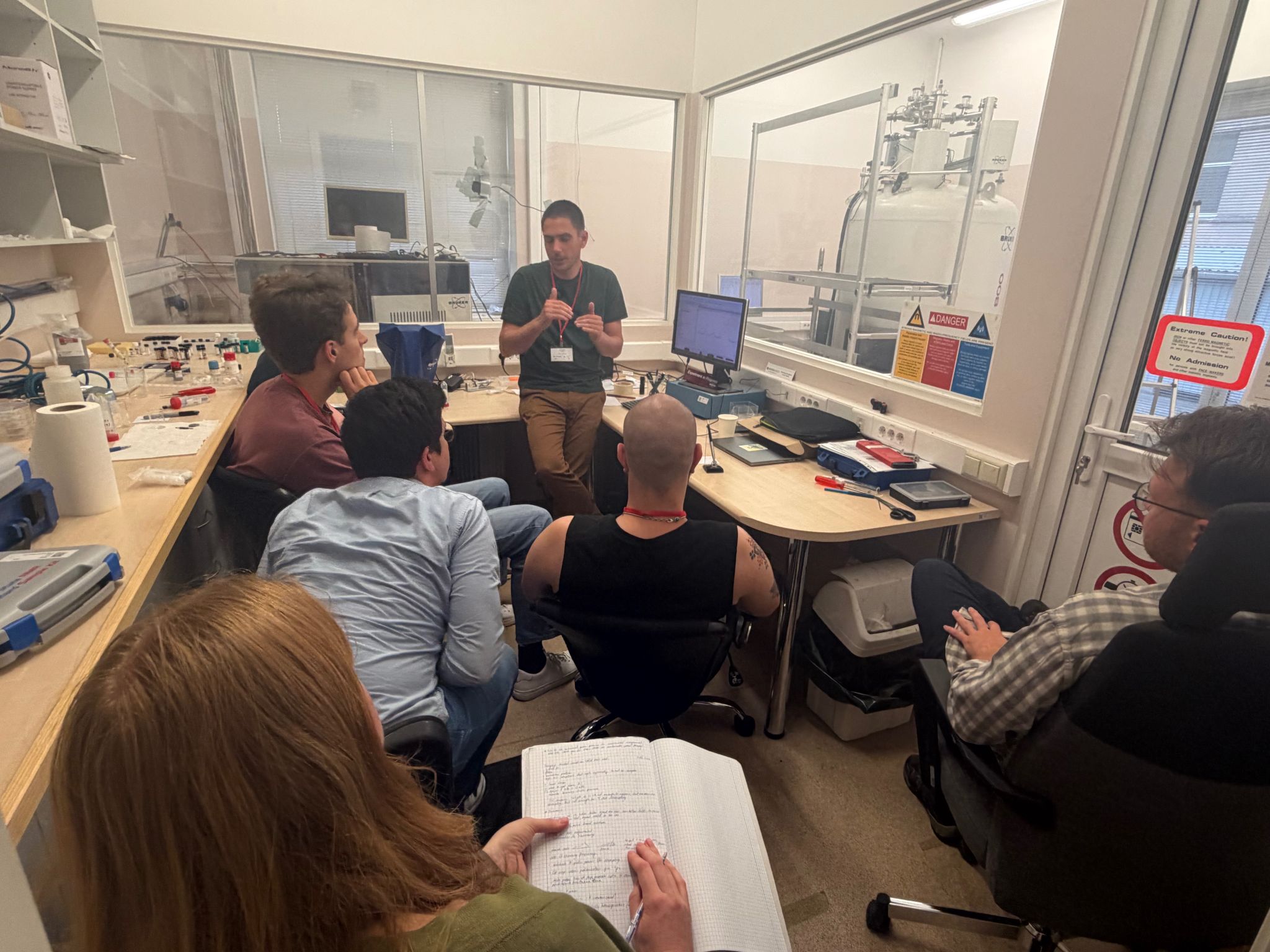
From 8–11 June 2026, the Instruct-ERIC Research Site Latvia and MR LATVIA successfully hosted the international training course "Modern NMR for Biomolecular Interactions: From Solution and Solid-State to Hyperpolarization and AI" at the National Institute of Research and Innovation (NIRI) in Riga, Latvia.
The four-day programme welcomed 20 participants from 11 countries, creating an inspiring environment for learning, collaboration and scientific exchange. The course attracted PhD students, postdoctoral researchers and early-stage scientists working in structural biology, biochemistry, chemistry and related disciplines, all seeking to expand their expertise in modern biomolecular nuclear magnetic resonance (NMR) spectroscopy and artificial intelligence (AI).
The programme combined lectures from internationally recognized experts with intensive hands-on laboratory sessions, giving participants the opportunity to explore state-of-the-art approaches for studying biomolecular structure, dynamics and interactions. Topics included solution-state and solid-state NMR spectroscopy, Dynamic Nuclear Polarization (DNP), hyperpolarization techniques, protein and nucleic acid NMR, molecular modelling, and AI-assisted structural prediction using AlphaFold3.
Over the four days, participants gained practical experience in sample preparation, NMR data acquisition, processing and interpretation, while learning how to select appropriate experimental approaches for different biomolecular systems. The integration of experimental NMR data with modern computational and AI-based methods demonstrated how these complementary technologies are transforming structural biology and accelerating structure-based drug discovery.
The scientific programme featured an outstanding international faculty from leading research institutions across Europe and beyond. Lectures were delivered by Harald Schwalbe, Guido Pintacuda, Roberta Pierattelli, Anne Schutz, Julien Orts, Mihajlo Novakovic, Vladislav Orekhov, Dennis Kurzbach, Kirill Zinovjev, Tanguy Le Marchand, Loïc Salmon, Linda Cerofolini, Tsyr-Yan Yu, and Alons Lends, whose expertise spans biomolecular NMR, structural biology, computational modelling and artificial intelligence.
The course was organized by the Instruct-ERIC Research Site Latvia in collaboration with CNRS (France) and CERM/CIRMMP (Italy). The organizing committee included Roberta Pierattelli, Guido Pintacuda, Kaspars Tars, Kristaps Jaudzems, and Alons Lends, whose combined efforts ensured a scientifically rich and interactive programme.
The training achieved its primary objective of providing young researchers with a comprehensive understanding of how modern NMR spectroscopy and AI can be combined to investigate complex biomolecular interactions. By the end of the course, participants had strengthened their ability to design NMR experiments, critically evaluate modern methodologies, interpret experimental data, and integrate computational tools into their own research projects.
Beyond the scientific programme, the course fostered valuable networking opportunities between participants and internationally recognized researchers, encouraging future collaborations within the European structural biology and biomolecular NMR communities. The interactive format, combining lectures, practical sessions and scientific discussions, created an excellent environment for exchanging ideas and sharing research experiences.
The successful completion of this international training course demonstrates the continued commitment of the Instruct-ERIC Research Site Latvia and MR LATVIA to advancing research excellence through high-quality training and international collaboration. By bringing together leading experts and early-career researchers, the course contributed to strengthening expertise in advanced biomolecular NMR and promoting innovative approaches that combine experimental spectroscopy with artificial intelligence for the future of structural biology and biomedical research.