

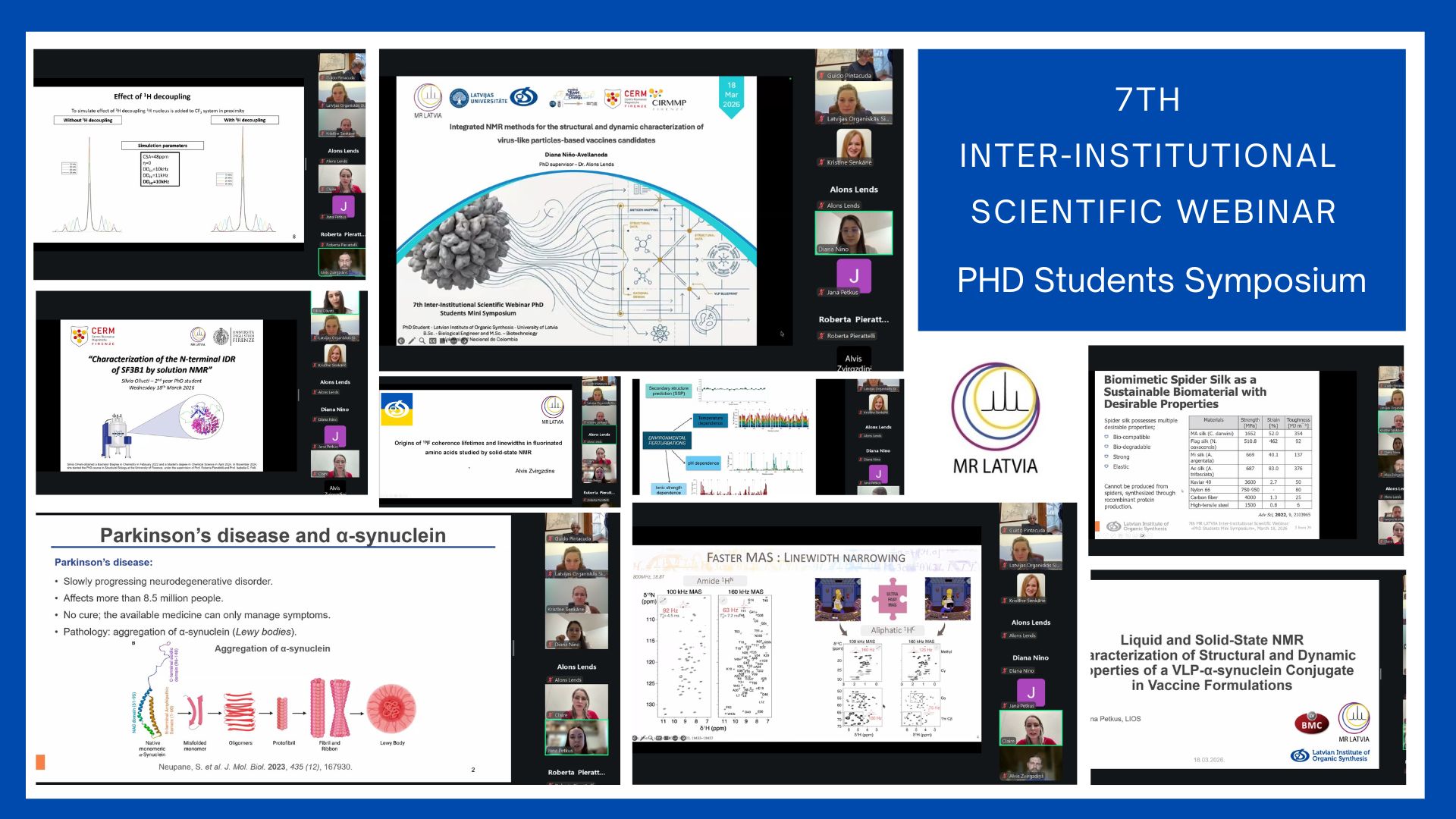
A recent PhD Student Mini Symposium brought together early-career researchers to present ongoing work in structural biology and nuclear magnetic resonance (NMR) spectroscopy. The event provided a focused academic setting for discussing methodological advances and experimental findings across a range of biomolecular systems.
The symposium opened with a presentation by Kristīne Senkane on structural studies of spider silk hydrogels. Her work examined the N-terminal domain of spider silk proteins and its ability to spontaneously form hydrogels at physiological temperature (37 °C). Using NMR spectroscopy, she investigated structural transitions associated with gel formation, including the effects of concentration, pH, and hydration environment.
Jana Petkus presented research on the characterization of virus-like particle (VLP)–alpha-synuclein conjugates as potential vaccine candidates for Parkinson’s disease. By integrating liquid-state and solid-state NMR approaches, her study achieved substantial sequence coverage and provided insight into structurally unresolved regions of the conjugate system.
Alvis Zvirgzdins reported on fluorine linewidth and coherence lifetimes in solid-state NMR, focusing on fluorinated amino acid building blocks. His work demonstrated that optimized proton decoupling techniques can significantly extend coherence lifetimes, with notable differences observed between molecular systems.
Diana Nino Avellaneda presented an integrated NMR-based approach for the structural and dynamic characterization of interleukin-31 (IL-31), particularly in the context of VLP-based vaccine development. Her results included high levels of resonance assignment and confirmation of the protein’s predominantly alpha-helical structure, while also addressing current limitations in sensitivity for conjugated systems.
A guest contribution from CNRS, delivered by Claire Ollier, focused on ultrafast magic angle spinning at 160 kHz and its application to high-resolution proton-detected NMR. The work demonstrated substantial improvements in linewidth and relaxation properties, alongside technical developments in sample handling and probe performance.
The final presentation, by Silvia Oliveti from CERM/CIRMMP, addressed the characterization of the intrinsically disordered N-terminal region of the SF3B1 protein. Using advanced multidimensional NMR experiments, her study explored protein–RNA interactions and the functional role of aromatic residues, particularly tryptophan.
The symposium concluded with a discussion session, where participants addressed methodological challenges, data interpretation, and future research directions.
This event highlighted the breadth and depth of current PhD-level research, as well as the continued development of advanced NMR methodologies in studying complex biological systems.
The webinar is supported by the MR LATVIA project (Development of Magnetic Resonance in Latvia) in collaboration with:
* Centre de RMN à très hauts champs de Lyon (CRMN), France
* CERM/CIRMMP Infrastructure, Florence, Italy
* Latvian Institute of Organic Synthesis (LIOS), Riga, Latvia
Funded by the HORIZON-WIDERA-2023-ACCESS-02 programme, this initiative aims to strengthen research capacities and scientific excellence across Europe.