

Solid-State NMR for Organic Chemistry, Catalysts, and Materials Research
📅 24 September 2025 | 🌐 Hosted online
The fourth MR LATVIA Inter-Institutional Scientific Webinar brought together researchers and students to explore how Solid-State Nuclear Magnetic Resonance (NMR) is advancing the frontiers of organic chemistry, catalysis, and materials science. This session featured invited talks from leading scientists at CRMN Lyon (CNRS), showcasing their latest discoveries and methodologies.
Key Presentations
✨ Dr. Wassilios Papavassiliou – Fast MAS Solid-State NMR and paramagnetic materials
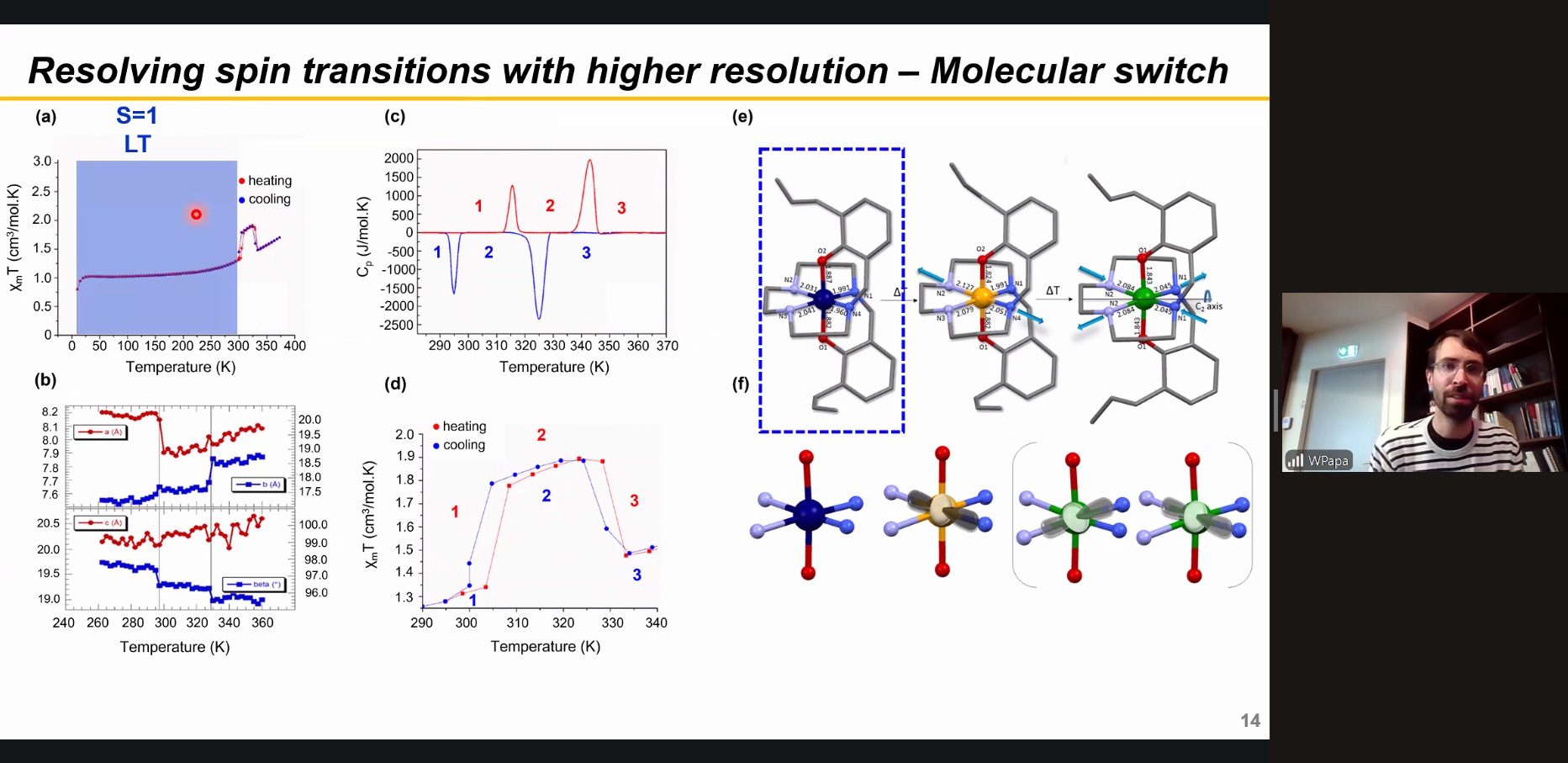
Dr. Papavassiliou demonstrated how solid-state NMR can unravel the complex behavior of spin crossover systems and frustrated antiferromagnets, despite the broad signals and hyperfine interactions characteristic of paramagnetic materials. He emphasized the role of fast MAS, broadband adiabatic pulses, and AMAT experiments, while noting that lower magnetic fields can be advantageous for dampening paramagnetic effects. His work highlights the potential of temperature-dependent studies to track spin transitions and hysteresis loops—paving the way for new insights in functional molecular materials.
✨ Dr. Teresa Insinna – Surface-enhanced DNP and catalysis
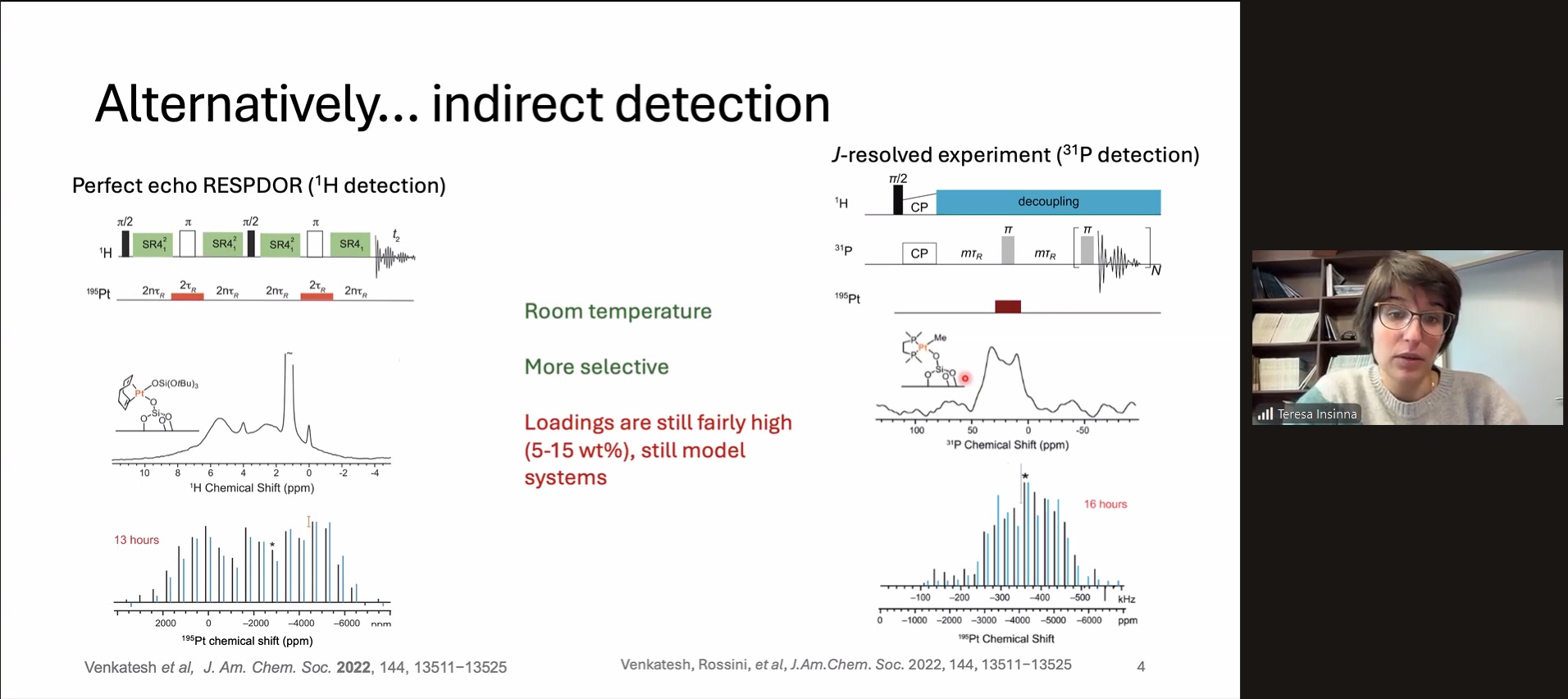
Dr. Insinna presented her development of Dynamic Nuclear Polarization (DNP) NMR methods to detect platinum in heterogeneous catalysts at very low loadings (0.3–1 wt%). Using J-HMQC and INADEQUATE experiments, she identified two distinct platinum sites and demonstrated how DNP dramatically enhances sensitivity. Her findings provide crucial understanding of catalytic processes and open new possibilities for designing sustainable energy technologies.
Broader Impact
For the organic chemistry and catalysis communities, these talks illustrate the transformative power of advanced NMR spectroscopy. From probing molecular structure and dynamics to detecting trace elements in catalysts, solid-state NMR is enabling discoveries that directly support the development of innovative materials and green technologies.
Collaboration & Support
The event also highlighted the importance of communication between NMR spectroscopists and synthetic chemists, ensuring experimental findings are closely aligned with real-world chemical challenges.
The webinar was organized as part of the MRLATVIA project (Development of Magnetic Resonance in Latvia), in collaboration with:
- CRMN Lyon (France)
- CERM/CIRMMP Florence (Italy)
- Latvian Institute of Organic Synthesis
This initiative is funded by the HORIZON-WIDERA-2023-ACCESS-02 programme to strengthen research capacities and foster scientific excellence across Europe.
Looking Ahead
We thank our speakers and participants for contributing to a lively and insightful exchange. The MR LATVIA webinar series continues to serve as a platform for advancing collaboration and innovation in the NMR community.